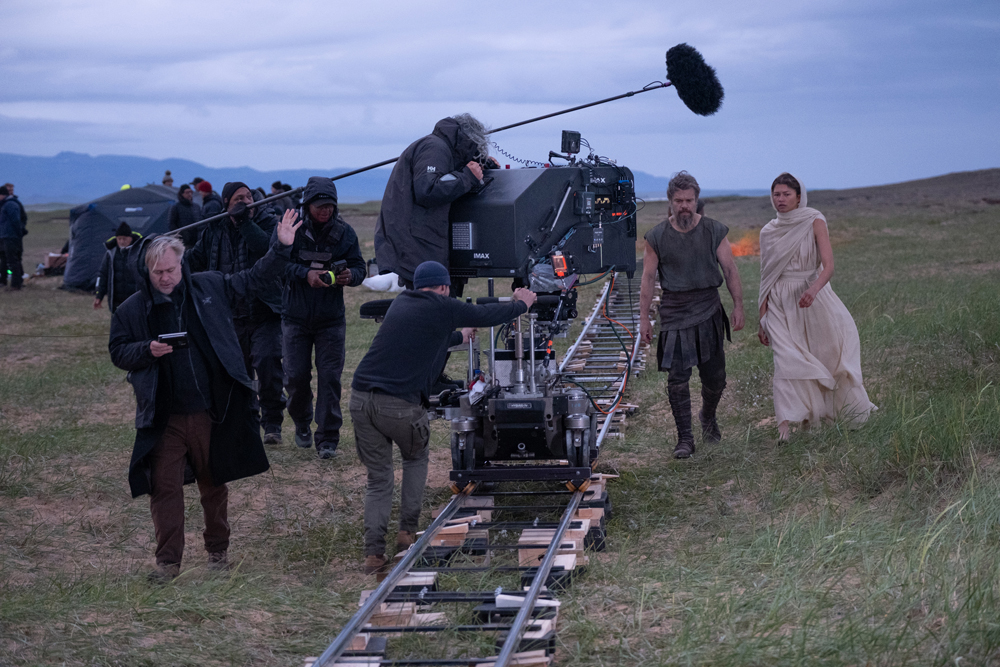
Willie Burton’s career has been defined by breaking barriers. In 1969, he became the first African American admitted to IATSE Local 695, the union representing production sound technicians, television engineers, video assist technicians and studio projectionists. Two decades later, he made history again, becoming the first African American to win an Academy Award for sound for Bird (1988), before earning a second Oscar for Dreamgirls (2006). Now, Burton has added another distinction to his remarkable resume by becoming the first production sound mixer to record a film shot entirely on IMAX cameras for Christopher Nolan’s The Odyssey.
“This movie was the most challenging and physically demanding production I have ever been on,” says the Alabama native, whose sound team included longtime collaborator and first boom operator Douglas Shamburger, second boom operator Adam Mohundro, and several local assistant sound technicians. The six month production spanned six countries and 91 shooting days, taking Burton and crew from Morocco, Greece, Italy, Iceland, and Scotland to the Universal lot in the United States.
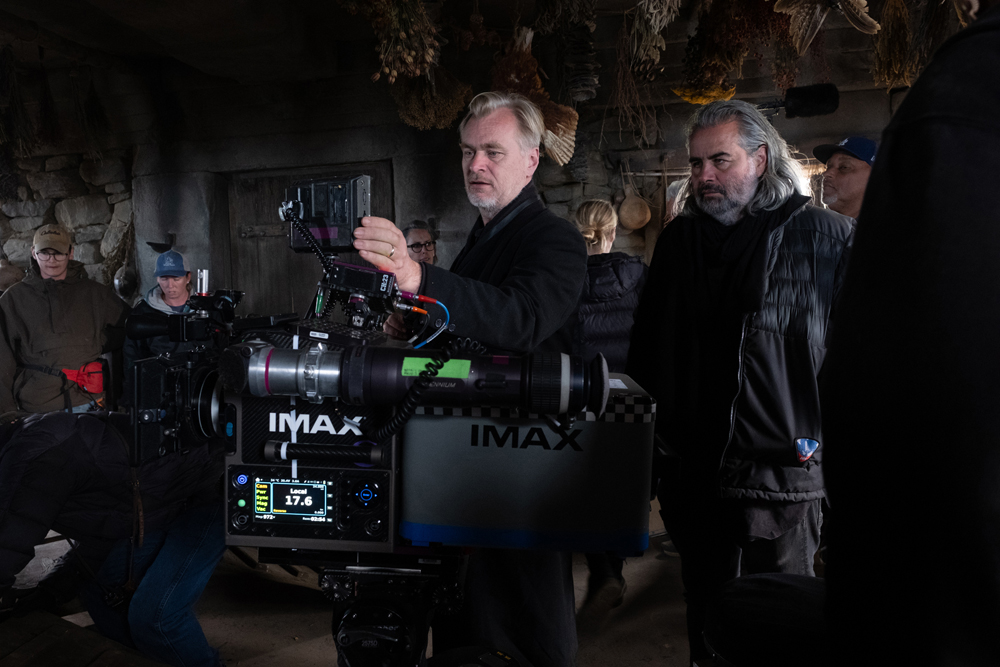
Nolan shot 2.1 million feet of IMAX film for the Homer epic. But perhaps the production’s more significant achievement was making it possible to record production sound alongside the images, something that had long proved difficult with IMAX because of the considerable noise generated by the large-format film camera. The breakthrough came with a redesigned camera, dubbed The Keighley, named in honor of the late David Keighley, IMAX’s longtime chief quality officer, who oversaw the production and quality of IMAX films for decades. The upgrade included a lighter body, newer electronics, and improved optics. But its most consequential innovation is a specialized sound-dampening housing known as the “blimp,” designed to muffle the camera’s operating noise. The technology allowed Nolan to rethink his approach to production sound.
The Odyssey marks Burton’s third collaboration with Nolan, following Tenet (2020) and Oppenheimer (2023). For the latter, Burton earned his eighth Academy Award nomination, third BAFTA nomination and fourth CAS Award nomination. But Burton will be the first to tell you he doesn’t do the work for the accolades. “I never think about what I may get in return. I always think about wanting to do a great job recording sound and the quality of my work,” he says. That philosophy has carried Burton through a career spanning more than five decades, with no signs of slowing down. After wrapping The Odyssey, he went on to mix a commercial for Ben Affleck and Jonah Hill’s upcoming comedy Cut Off, starring Kristen Wiig.
But Burton’s involvement in The Odyssey almost didn’t happen. He was committed to another project until budget cuts ultimately forced him out. “If it hadn’t fallen through, I would have been somewhere in Africa because it overlapped with Chris’s film,” he says. “Chris doesn’t let you know too far in advance when he’s going to start. Sometimes it can be all of a sudden, and you’re like, OK, we’re going.
To prep, Burton visited an office to read the script which isn’t emailed to prevent leaks – a familiar protocol for Nolan’s films. On the page, the locations sounded manageable. “I was like oh this is great, we’re going to be in a cave, we’ll be in a palace, we’ll be in these different locations. I’ll be able to be outside with my setup. I can find a nice room to get away in. I’m going to be good,” Burton recalls while reading it.” But the tech scouts quickly put to rest any ideas that this job would be easy.
Prepping The Keighley
Nolan shot The Odyssey on a new IMAX camera that reduces ambient noise. How much? Testing for it began before shooting Oppenheimer.
Burton: “In prepping Oppenheimer I was involved with some of the testing. I went to Orange County and spent time with the company that was designing the blimp for the camera. They had different blimps and prototypes, and they would let me listen to each one. And it would cut down the noise a little but it wasn’t working as well. They needed to add more sound proofing layers, so we sort of gave up the idea of using the blimp on Oppenheimer.”
“So when we got to The Odyssey another company was working on the blimp. I didn’t have any input on its design but [executive producer] Tom Hayslip called me one day and said Willie we’re doing some tests on stage, why don’t you come down. So I went down with a handheld recorder to test the blimp. At first, they were surprised I just brought this tiny handheld recorder but I knew it was all I needed. They showed me the blimp and it was a huge box. It must have weighed 200 pounds. My first reaction to it was how anyone was going to bring this blimp around on location. So they put the blimp on the camera and I’m standing not too far from it and I’m waiting. I asked them when they were going to turn on the camera and they said the camera was already rolling. I was like, oh my god, this is incredible. This sounds great.”
The Keighley Workflow
Asked how he approached recording dialogue with the new IMAX camera, from his choice of microphones to the use of low-cut and high-pass filters, Burton walks us through his workflow.
Burton: “When there were lines of dialogue on Oppenheimer, Chris would want to shoot the close-ups with the 65mm camera so that it’s quiet enough for sound takes. Chris would want to do that instead of ADR to have the actors in character for the scene. But on The Odyssey, we didn’t have to do that anymore because of the blimp. We did do a few sound takes and wild lines during filming but only when it was necessary, like if we didn’t have the blimp on the camera.”
“So when I’m recording and mixing, I use a little bit of low-cut. I don’t have a special filter but it’s just the one built into my Zaxcom Deva 24. I roll a little bit of the low-end off just so you don’t get the rumble from the boom noise and everything. But I used just enough roll off for that and nothing extra for the IMAX camera. But I’d imagine in doing so that also helped roll off any other noise from the camera as well.”
“When we were somewhat close to the camera, you might get a tiny bit of roll off but we try to let post-production take care of most of that. By doing that, post can pre-set it to the levels they want with their software and it can remove any constant low noise. But when we were really close to the camera it can be louder. But we were far enough away during production that we didn’t hear it. Plus, with the location noises happening, we really didn’t notice any camera noise because of all the other noise coming in. It all gets filtered together. So we were very happy with the blimp and it allowed us to work how we normally do.”
A GIANT Attacks
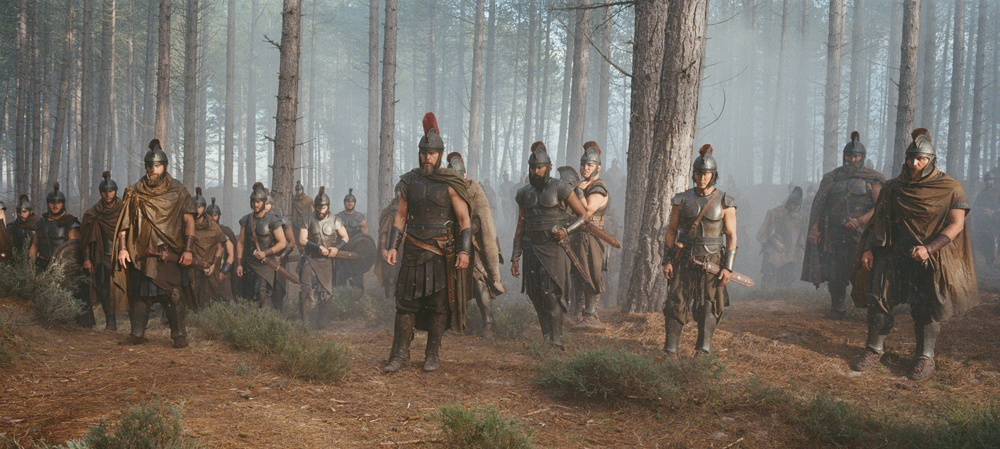
Locations in Greece provided the backdrop for a climactic sequence in which Matt Damon’s Odysseus and his soldiers come face to face with a giant monster inside a cave. Trapped, the men scramble to find a way out. And, oh yeah, there are sheep.
Burton: “We were at a beautiful beach area in Greece and to reach the cave there is all these rocks, uneven terrain, and everything. So you needed a good pair of hiking boots, and luckily, I was in good enough shape. But then when you got to the top, you’re like oh my god, this is a huge cave.”
“During the scout I was trying to imagine everything Chris is going over and I thought the sound of the location wasn’t bad. Then Chris said he wanted to put a speaker inside high up because we have an actor for the voice of the cyclops. So this actor would make noises and everything into a microphone that would broadcast through the speakers. For that, we ended up setting up a wireless system with speakers and the sound bounced all over the walls. It was great because it gave you the natural sound of the environment. It was real.”
The challenge for Burton’s sound team, and the rest of production, was bringing the gear to the cave.
Burton: “We had a helicopter take the speakers up to the cave because it was too far to be carrying all the heavy stuff. But other than that, we had to physically walk the equipment up every day and bring it back down. Knowing we would be doing that, I asked for a local sound assistant to help carry the equipment. I did that because you have to keep in mind if the call time is 7AM, with Chris, you need to be ready to go at 7AM.”
With the long hike Burton mixed with his portable setup.
Burton: “I usually work with a sound cart but we very rarely used a sound cart on this job because there is just no room. Inside the cave you got smoke machines going, fans, hay, and of course the sheep. So I would use my Zaxcom Fusion, which has better knobs for operating, and it’s more conditioned for portability than my newer Zaxcom equipment. For this scene, I was mixing between 4-5 microphones with our two booms and any wireless mics. But the sheep were probably the most challenging. They would bring the sheep in and out as they were needed and I am in the corner and the sheep would be biting at me and the equipment. The animal wrangler would move them away but they would just come back.”
“We did use some body mics but tried to limit them as Chris prefers the overhead mic. But the nice thing about this sequence is we had a second boom operator. We could get the master shot, but we also put wires on to protect ourselves. Chris realized we had a fight on our hands and we had to do something.”
“The thing with the actors, the vest they had on is metal armor. It was not easy. We were very fortunate with Matt Damon’s character as his armor was a little bit under his neck so we could place a mic in there. But for most of the other actors, we would put a mic all the way underneath their chin. Sometimes the sound wasn’t quite that good so we would use the boom for the closer shots. So that’s what we ended up doing. We used the boom for most of the closer shots or when the sound quality of the bodypack mics wasn’t to my satisfaction.”
“Even on the wide shots, we got the booms going because Chris liked the feel. He liked the sound, the echo of the cave because that’s the location. That’s what you get in there. There were even some bees near the entrance of the cave. Luckily, they didn’t sting anyone but we said let’s get some sound of the bees so we have everything. With Chris, that’s what you do. We record everything.”
A Trojan Horse
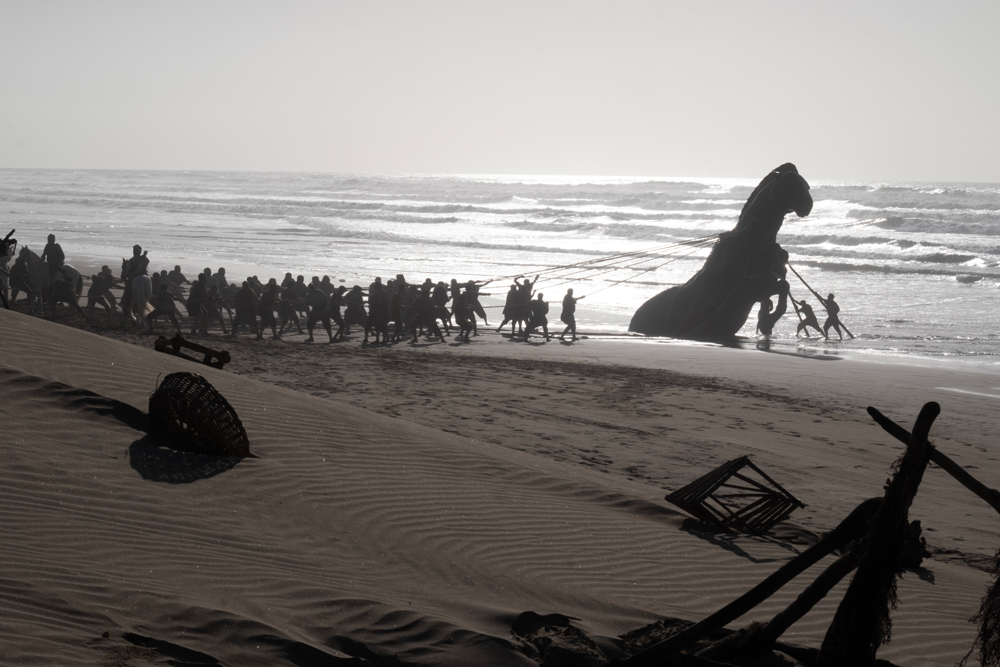
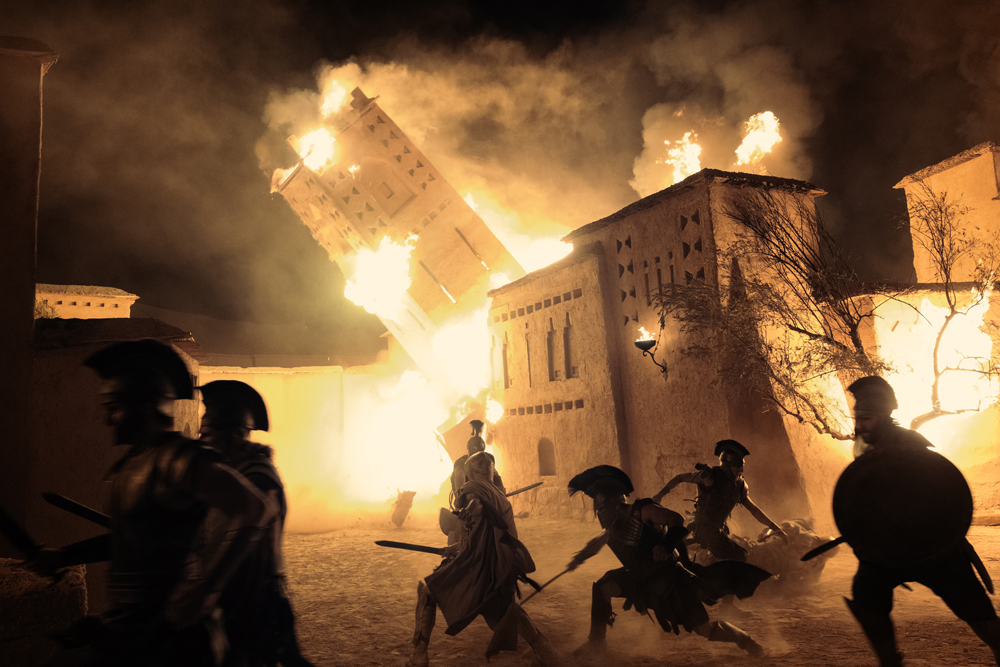
Nolan’s The Odyssey takes audiences inside the infamous Trojan Horse, the Greeks’ deceptive gift to the people of Troy. For the interior shots, the production built a practical horse with several actors positioned inside. As the structure was rolled into the city, the confined space helped create the claustrophobic feeling of being trapped inside.
Burton: “We’re shooing inside the horse, and there’s water inside and everything. It was all done practically. We attempted to place a plant mic but we couldn’t find a good position for it. So my boom operator Doug Shamburger placed the overhead mic inside whenever we could. With one of the sides open for the camera we were able to put the boom right up to the actors to recording everything which sounded really good to use during production.”
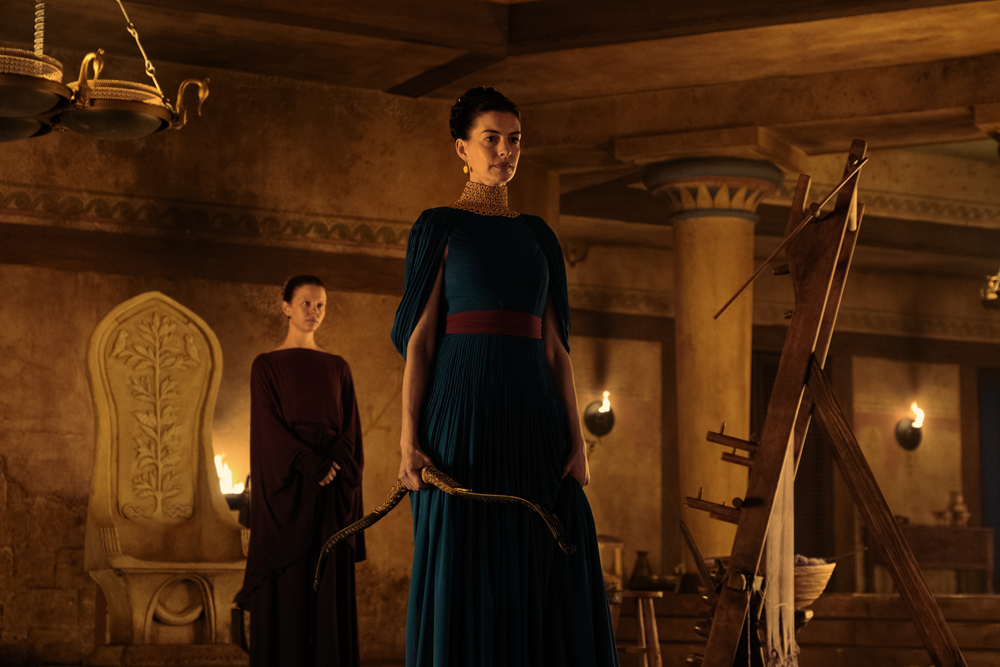
Photo: Melinda Sue Gordon/Universal
A Hall of Suitors
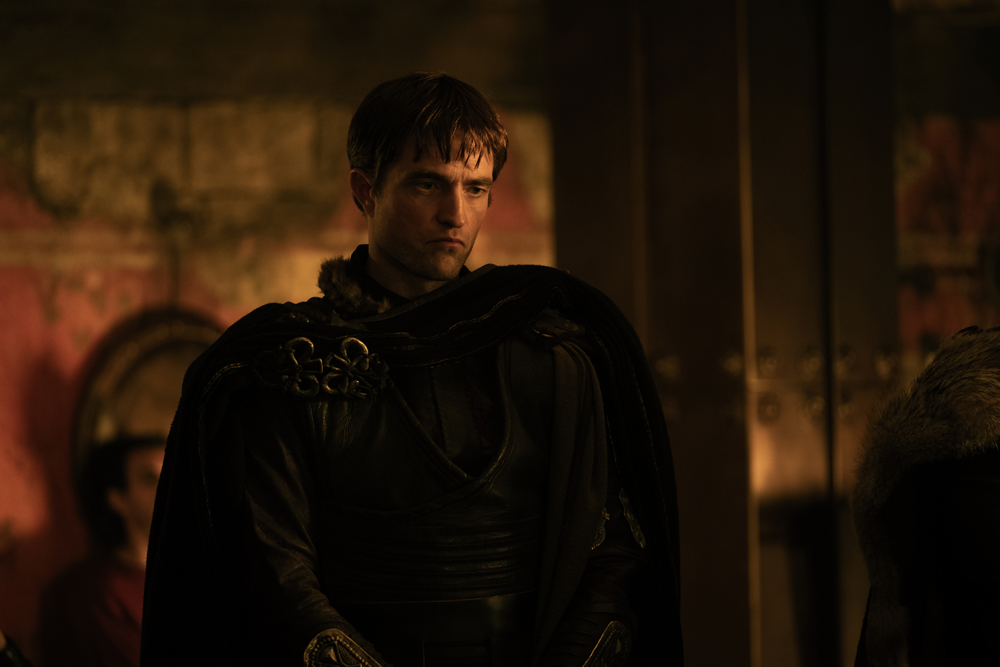
With Odysseus gone from Ithaca for decades, a group of suitors has taken up residence in his palace, vying for the hand of his wife, Penelope (Anne Hathaway). Still loyal to her husband, Penelope does everything she can to delay choosing a new one, while her son, Telemachus (Tom Holland), sets out to uncover the truth about his father’s disappearance. The story builds to a final test devised by Penelope: whoever can string Odysseus’s bow and shoot an arrow through a series of axe heads will win her hand in marriage. But who, if anyone, can pull it off?
Burton: “We were on a stage at Sony and I was able to use a small sound cart that I made on Tenant. It’s a very simple setup with my Deva 24, Mix-16 and I was able to sit just outside the set with more control. We could get in there with the boom but we did have a few wires going too. Chris will come in the morning and we have a walkthrough and my entire team will watch rehearsals with everybody involved. We can give our input and then Chris will lay out a whole bunch of shots for the day ahead. Then we have an idea of what we can do and how we can approach the scene if it’s wide or tight, or the number of actors.”
“When I’m mixing the wireless mics and the boom, I start with the boom to get the feel of the room. I want to bring in some of the environment from the boom to help smooth out the wireless mics. I try to make it consistent where the wider the shot you’re pumping in more of the boom to smooth it out. I don’t know how other mixers mix but I heard some say, they want the boom to totally be off. To me, if that’s the case, you don’t get the natural sound of the room.”
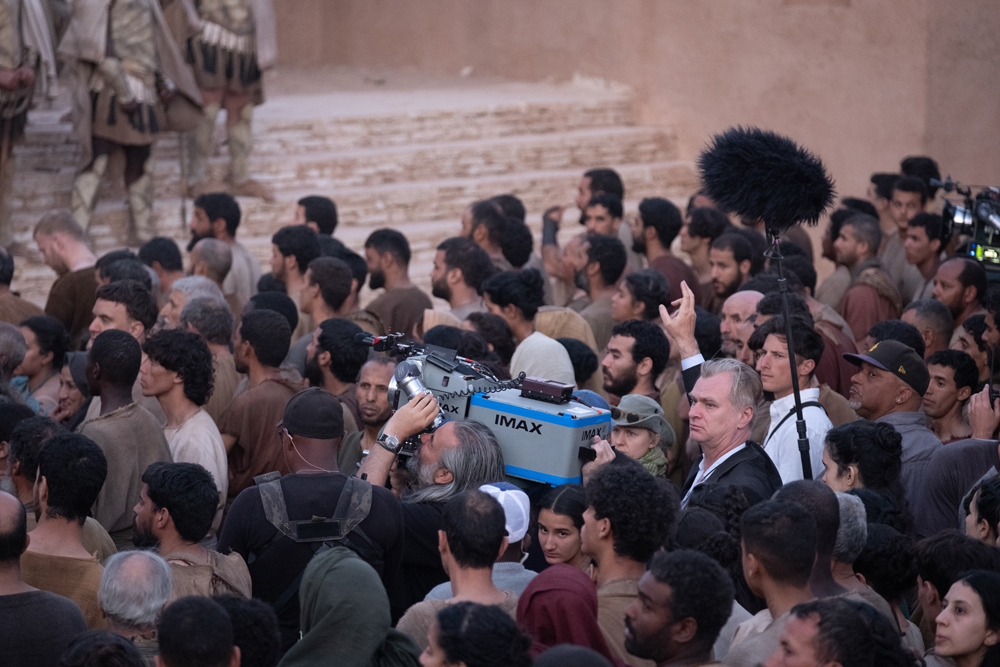
Photo: Melinda Sue Gordon/Universal
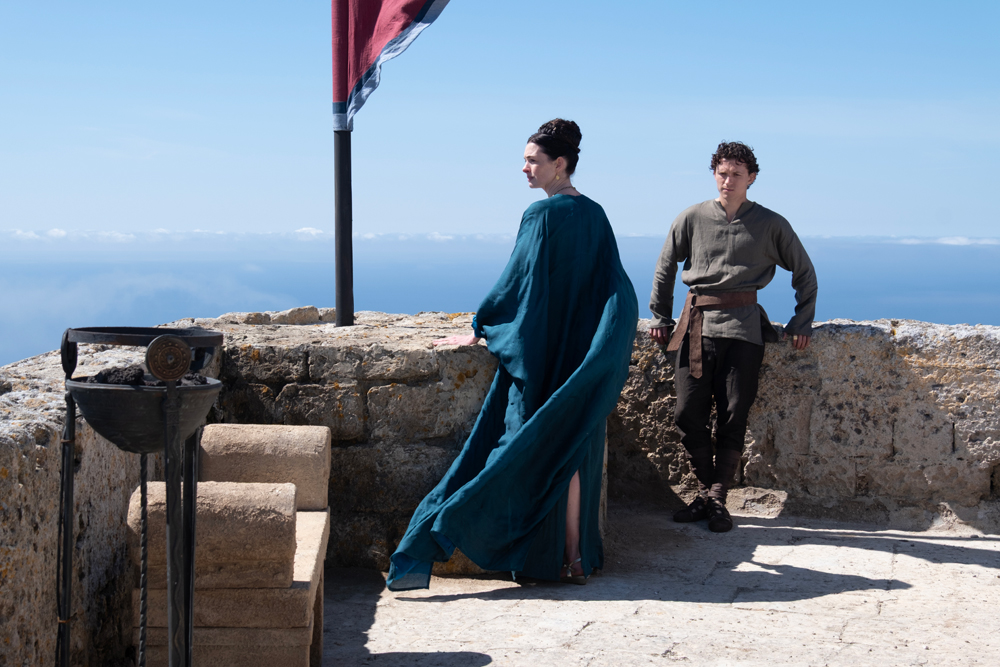
Photo: Melinda Sue Gordon/Universal
When in Favignana
Off the west coast of Sicily, the island of Favignana serves as the stand-in for Ithaca, with locations across the island providing the backdrop for several key moments. Castello di Santa Caterina becomes Odysseus’s palace, while Cala Rossa is where Telemachus sets out in search of his father. The production also built a small farmhouse on location to serve as the home of Eumaeus (John Leguizamo). On the island’s eastern side, Bue Marino Beach stages Odysseus’s return, while the small islet of Preveto, just off the southern coast, was transformed into a mythological village.
Burton: “When we scouted the castle, we found out quickly how far the castle was up on the hill. It was huge. I was thinking maybe some kind of transportation would take us up there, but no, we had to walk. There was no way of using transpo because of how the bricks and pathway was laid out. It was a nice path to walk on but it zigzagged a lot. So as I’m walking, I’m not in bad shape, but you still had to stop and rest a bit. There were a lot of us who were taking a rest. It took about a half an hour to get from the bottom to the top. And since Chris doesn’t go through his scouting route until everybody gets up there, when people made it to the top everyone applauded.”
“So when we were scouting, I was thinking about how we’d have to walk this every day early in the morning with our equipment. Luckily it was decided that it would be ok for department heads to take a helicopter up during production. I asked and was lucky enough to get my boom guys on the helicopter but our sound assistant Manfredi Melodia had to walk up. I felt sorry for him but he was a trooper.”
“When we got into production, the helicopter takes you up a bit but we still had to walk up some ways to get to the castle. Then when we wrapped at night we all had to walk back down because there couldn’t be a helicopter flying at night. What helped was they built these tents near the location to store our equipment every night.”
“A lot of our challenges on Favignana were carrying the equipment all over. We had to walk to a lot of different areas, beaches, and for scenes at the farmhouse which they built about halfway up between the beach and the castle. Then no matter if we were in Morocco or Favignana, the wind was always blowing.”
“There’s a scene between Tom Holland and Anne Hathaway in the castle overlooking everything and the wind was blowing like crazy. I mean, things are flapping around but we still have to get the sound. We ended up using the boom and wireless with all the wind gags and wind covers to protect it. So it’s always a challenge to work in the wind. But then actors sometimes would deliver a line very soft and you got to try and pull it out. Plus, with Chris, if we are not far away, we are still using hardwire when we are booming because he likes that sound. There were times the boom had to be wireless because it’s impossible to run a cable but anytime that we could have a cable on the boom microphones we jumped back to hardwired.”
Sailing Treacherous Waters
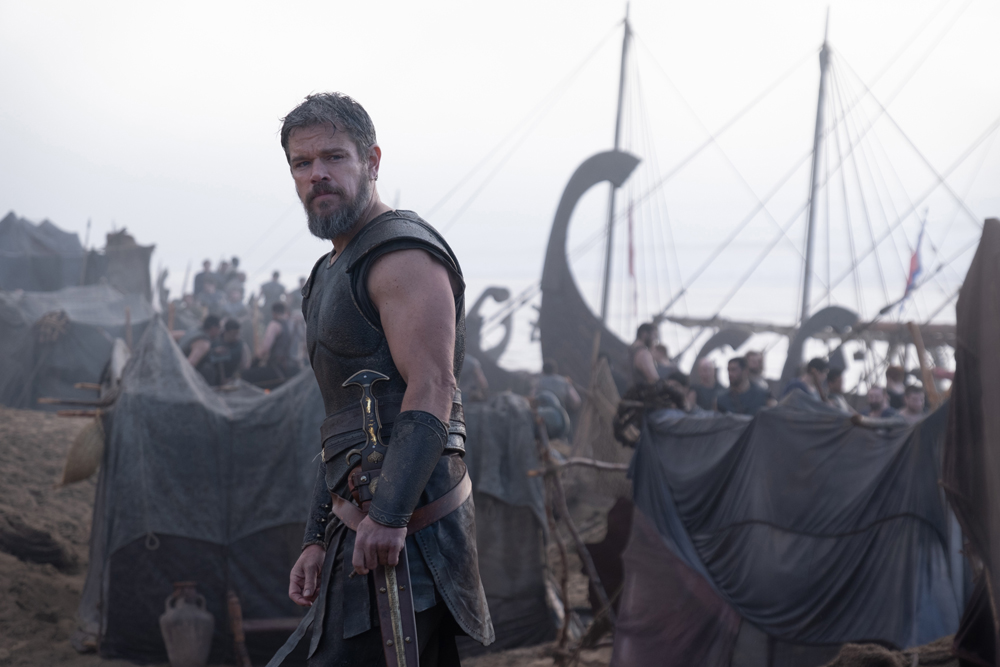
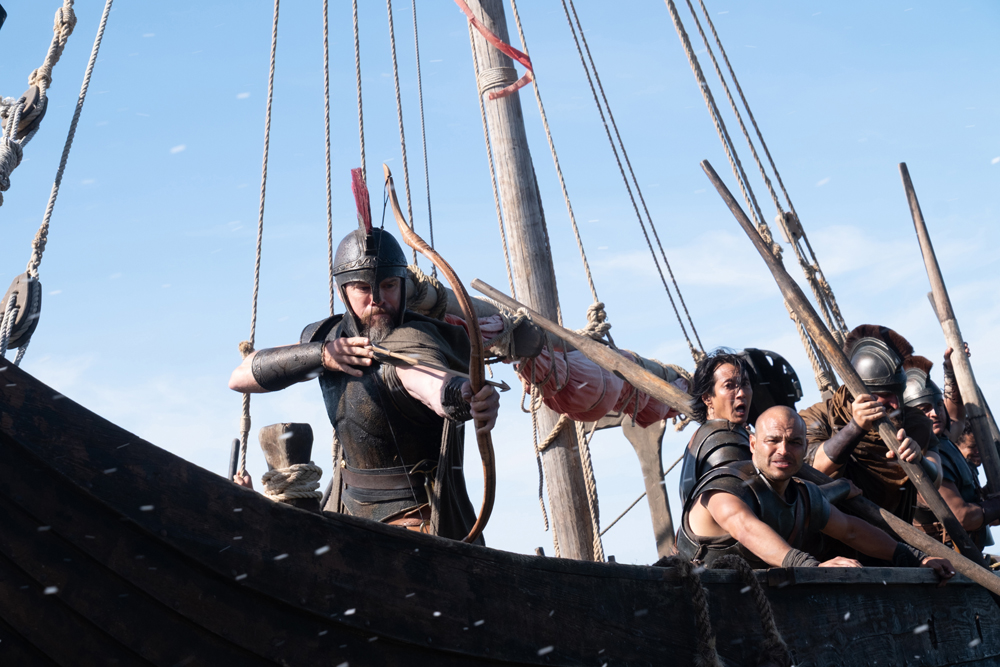
Much of Odysseus’s journey home takes place at sea, where he and his men encounter Sirens, an island of the dead, an enormous whirlpool and plenty of other dangers along the way. Rather than relying entirely on visual effects, the boat sequences were staged practically. Burton, meanwhile, found himself working down on the lower deck, recording sound amid the action.
Burton: “In prep, we looked at the boat and we said okay, how do we make this work for us. We eventually did a couple early scenes in the boat and I had some rain gear designed to put underneath the recorder. So I tried to stay up top all the way forward on the boat with my Zaxcom Fusion and portable equipment. We were able to be behind the camera and see everything so I thought it would work out. But that was just preliminary boat stuff. I soon realized that I was going to be in the way once we started to do the major boat sequences. I wasn’t going to be able to mix in that spot once we got going.
“That’s when Chris told me there’s a hole underneath the boat. So I was thinking well, where’s the whole? Doug and I checked it out and it didn’t smell good. It’s where they kept all the supplies. But there were a couple tables and I thought I could set up down there. Some of the ship people were telling me it gets pretty rough down there and asked if I was sure I wanted to be in there. But I had to go down there because there wasn’t really anywhere else I could go. So I cleaned off a part of the table and put down furniture pads to set up my equipment.”
“What we decided to do then was run cables underneath the planks to both sides of the ship. So no matter what side of the boat we were on, we would have a wired boom working on either end. We hid them underneath the planks because we couldn’t have anyone tripping over cables when we were sailing. We also set up wireless receivers and everything wireless so you wouldn’t see them on the ship. But if for some reason we were unable to get a wireless signal, we could have the boom operator hook into the cable and we wouldn’t hold up any of the production.”
“Once we started shooting, I ended up being sort of a clerk down below. Every time somebody wanted something they would ask me to hand them this thing or that thing.
It got to a point that they said okay this is Willie’s Hole and made me a sign. And overall I was doing pretty good down there. I would come out for lunch or they’d bring me sandwiches. There’s some rocking and rolling but I’m okay because I worked for the government for a while on ship. So I know how to get your sea legs.”
“But then for the sequence where we have a big storm, it wasn’t raining but they were going to shoot all this water on the ship. I’m down below and once they said action, all the water just poured down so I had to quickly cover the equipment. Luckily we didn’t ruin anything. I thought I was safe but then I looked up and saw all these little cracks above me. So we took plastic and sealed the top where water couldn’t get to me anymore.”
“Close to the end of being on the ship we had our roughest day since we’ve been out. The ship would just rock it up and down and roll over sideways, it was bad and I’m thinking oh boy, this is one day that if I’m going to get seasick this would be it. We had a few people get sick but I kept telling myself I can’t get sick, I can’t get sick. I kept thinking as I was doing my mixes and by the end I didn’t end up getting sick.”
Visiting the Underworld
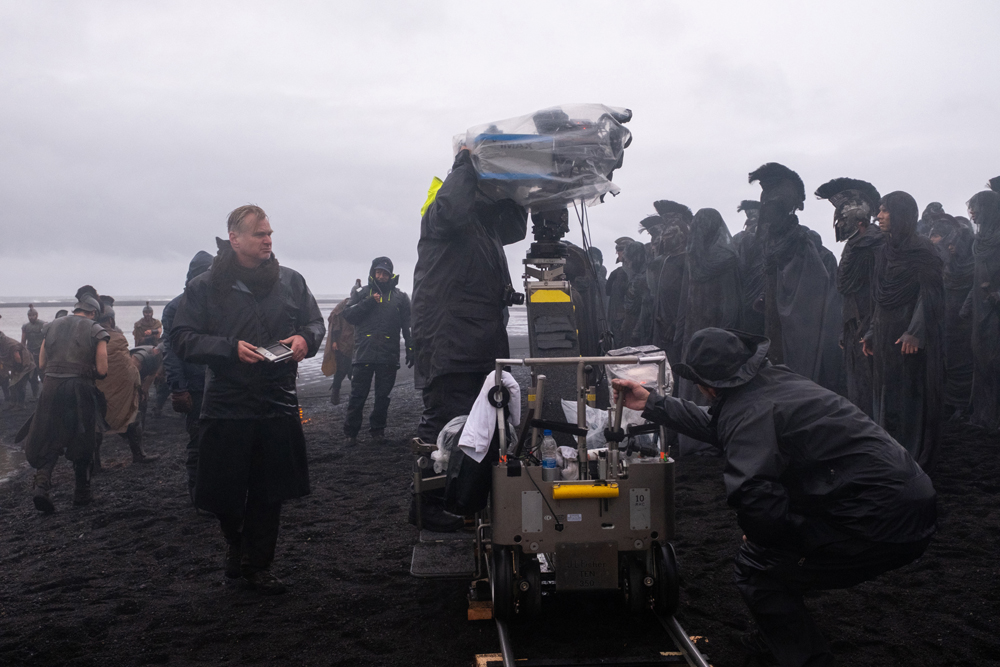
The remote, black sand shores of Hjörleifshöfði in Iceland double as the Underworld, where Odysseus journeys to the realm of the dead and encounters Sinon (Elliot Page) and Tiresias (James Remar).
Burton: “This was a location I thought maybe I could roll my cart out but Chris didn’t want to see the wheel tracks. So we had to use the portable right. Every location we went to we had to be portable. And with Iceland, everything is a little misty and sort of raining a little bit. Not heavy but you had to put on a raincoat and cover up the equipment with plastic to be safe. They’re just things you end up doing that become part of your routine.”
Team Effort
With all the massive set pieces, elaborate locations and action sequences, Burton found his way through plenty of challenges. What surprised him, though, was just how dialogue-heavy the film turned out to be.
Burton: “There was a lot of dialogue because of the story and large cast. And without a good sound team, I mean, I couldn’t use any person that didn’t have a lot of experience. Luckily for me, I got Doug, who is a real pro, and Adam, who’s a younger guy, but he has a lot of experience. So I don’t have to tell them what to do. They know how it works. They’re thinking before me and they’ll come say I’m going to do this and this. And if I have a suggestion, I give it to them and we work as a team.
“We’re always involved and we’re always figuring out things to get the best possible sound. And we know what Chris wants and we try to record all the sound effects everywhere we go. We try to get all the sound effects that we can. And the nice thing about working with Chris, his editors are right there for dailies. And of course, I go to dailies every night with my whole team and then they tell us if they need something.”
“And towards the end they said, Willie, we need more of the oars. We need more sounds of the beach, of the ocean. So we record all those kinds of sounds. It’s nice to work with the editors because they know what’s missing as they cut. It makes for a good sound film because we provide them with everything they need as we go which hopefully allows post-production to have less work to do.”
The Final Chapter?
We asked Burton if he was considering hanging up the proverbial sound recorder. He stopped short of saying he was ready to retire. Instead, suggesting he’s “not really looking for a sound job but if the right job comes along” he’d consider dusting off the Zaxcom equipment.
For now, the CAS Career Achievement Award winner is turning his attention to a few personal projects. He’s begun working on a proposal for his autobiography and has started taking on speaking engagements, including upcoming appearances at Baton Rouge Community College and the LightReel Film Festival in Washington, D.C. “It’s amazing. At this stage in my life, in my career, it can’t get any better than this,” he shares. “I’m excited now because I just want to give back. I’ve been successful and blessed over the years, I want to inspire young people who want to be filmmakers.”
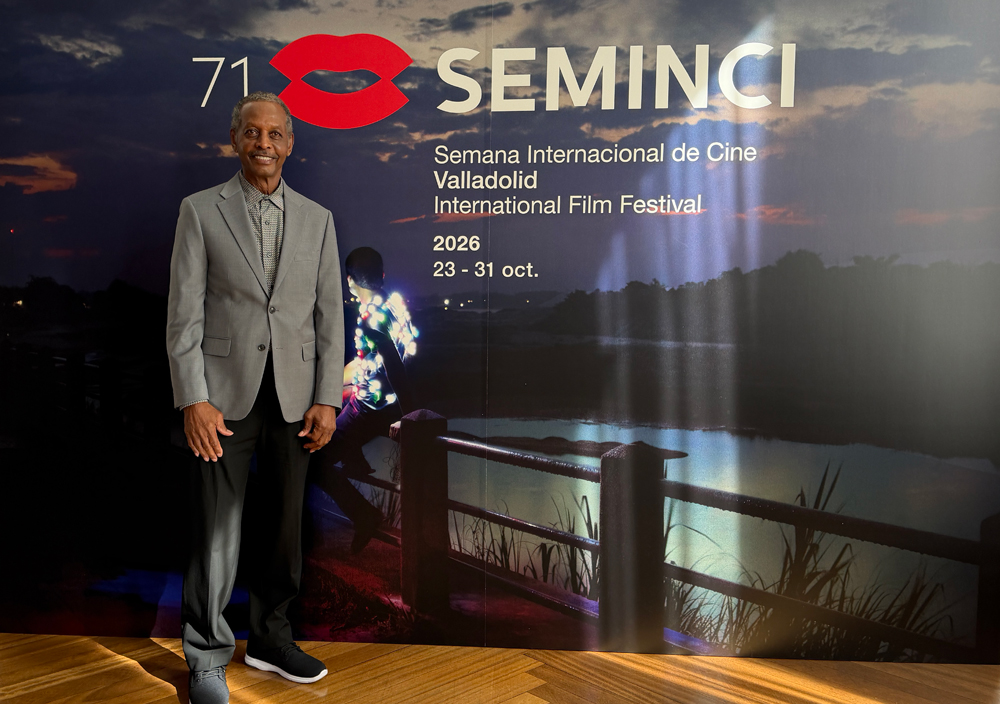
Since our conversation, Burton received the Honorary Spike at the 71st Valladolid International Film Festival. The prestigious award has never before been presented to someone in sound — another first. But perhaps for Burton, the recognition is only part of the reward. As Homer famously wrote, “A man who has been through bitter experiences and travelled far enjoys even his sufferings after a time.”